Zorays Solar Pakistan
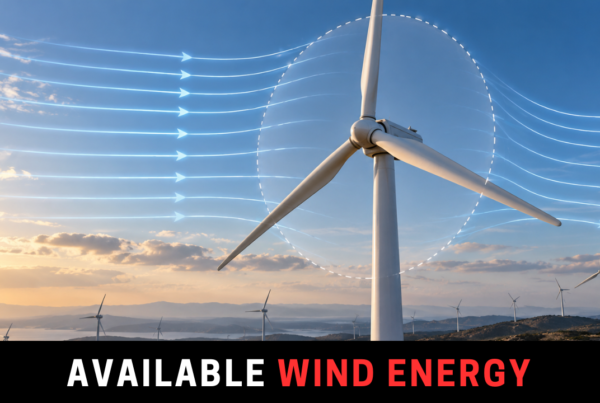
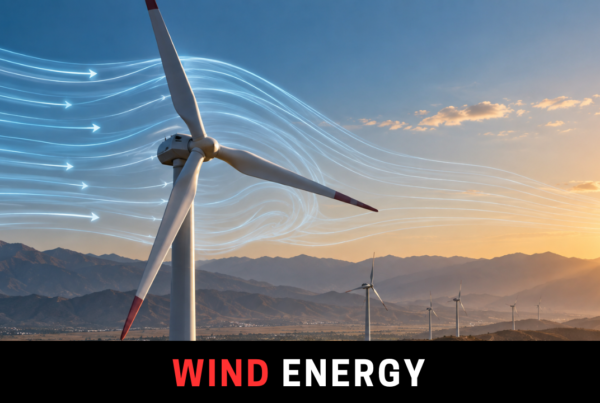
Imagine standing behind a wind turbine on a windy day.
The blades are extracting energy from the moving air, turning a rotor that ultimately helps generate electricity. The obvious question is surprisingly fundamental:
If wind contains energy, why not build a turbine that captures all of it?
A perfect turbine, one might assume, should extract 100% of the available wind power.
Except such a turbine could not work.
If a turbine removed all the kinetic energy from the air passing through its rotor, that air would have to leave with zero velocity. It would effectively stop behind the turbine. With nowhere for the air to go, fresh wind could no longer continuously pass through the rotor.
The turbine would defeat itself.
This deceptively simple problem leads to one of the most important limits in wind-energy engineering: the Betz limit.
Even an ideal wind turbine cannot extract more than approximately 59.3% of the power available in the wind.
Understanding why tells us considerably more about wind turbines than the number 59.3% itself.
Wind Is Moving Mass, and Moving Mass Contains Energy
Wind is simply air in motion.
Anything with mass moving at a velocity possesses kinetic energy:
KE = ½mv²
A turbine, however, does not receive a fixed lump of air. Wind continuously moves through the circular area swept by its blades.
That means we need to know how much mass passes through the rotor every second.
For air density ρ, swept area A, and wind velocity V, the mass flow rate is:
ṁ = ρAV
Power is energy transferred per unit time. Substituting the continuously moving mass of air into the kinetic-energy relationship gives:
Pwind = ½ρAV³
This is the power contained in the incoming wind.
And notice something important immediately:
V is cubed.
Mukund R. Patel, in Wind and Solar Power Systems, describes upstream wind power as varying linearly with air density but with the cube of wind speed.
This means a 10% increase in wind speed does not produce merely 10% more available wind power.
The theoretical increase is:
1.1³ = 1.331
or approximately 33.1% more power.
That is one reason wind-resource assessment matters enormously when deciding where turbines should be installed.
But the equation above describes the power in the wind.
It does not mean the rotor gets all of it.
The Air Must Leave the Turbine
This is the easiest way to understand the Betz limit.
Imagine three positions along the airflow:
Before the turbine → At the turbine → After the turbine
Call their velocities:
Vu = upstream wind velocity
Vb = wind velocity at the blades
Vd = downstream wind velocity
If the turbine is extracting energy, the air must slow down.
Therefore:
Vu > Vb > Vd
But Vd cannot become zero if continuous airflow is to be maintained.
Patel puts the central physical constraint succinctly: “some power is left in the downstream air,” which continues moving at reduced speed.
That one sentence explains why 100% extraction is impossible.
The turbine needs the wind to leave so that more wind can arrive.
A Wind Turbine Extracts Energy by Slowing Air — Not Stopping It
Now the turbine becomes easier to visualize.
Imagine a stream of air approaching the rotor.
Before reaching the blades, the air begins slowing.
It transfers some of its kinetic energy to the rotor.
It then emerges behind the turbine at a lower velocity.
So the turbine’s mechanical output corresponds to the difference between the kinetic power arriving upstream and the kinetic power remaining downstream.
In simplified form:
Power extracted = Upstream wind power − Downstream wind power
Or:
Pout = ½ṁ(Vu² − Vd²)
This is also how Patel develops the problem: the mechanical power extracted by the rotor is obtained from the difference between upstream and downstream wind powers.
The interesting question is no longer:
How do we stop the wind?
It becomes:
How much should we slow the wind to extract the greatest possible power while maintaining continuous airflow?
That is a much more useful engineering question.
Why Is Wind Speed at the Rotor an Average?
There is an elegant relationship at the centre of the ideal wind-turbine model:
Vb = (Vu + Vd) / 2
In words:
The wind velocity through the rotor is the average of the upstream and downstream velocities.
There is an intuitive way to think about this before touching the mathematics.
The rotor does not encounter completely undisturbed upstream air, because the presence of the turbine already influences the approaching flow.
Nor is the air at the rotor already moving at its final downstream velocity.
The rotor lies between those two states.
In Patel’s treatment, the mass flow through the rotating blades is consequently calculated using the average of the upstream and downstream velocities.
Therefore:
ṁ = ρA[(Vu + Vd)/2]
Now substitute this mass flow into our extracted-power equation:
Pout = ½ṁ(Vu² − Vd²)
giving:
Pout = ¼ρA(Vu + Vd)(Vu² − Vd²)
We now have an expression describing how much power the turbine extracts depending upon how fast the wind is allowed to leave.
And this produces a fascinating result.
Maximum Power Occurs When the Wind Leaves at One-Third Speed
Suppose the upstream wind velocity is:
Vu
We can vary the downstream velocity Vd in the equation above and ask where turbine output reaches its maximum.
At one extreme:
Vd ≈ Vu
the turbine has barely slowed the air.
Very little energy has been extracted.
At the opposite extreme:
Vd → 0
we encounter the physical problem discussed earlier: the air cannot simply stop behind the rotor while continuous flow is maintained.
Maximum extraction therefore occurs somewhere between these extremes.
The mathematical maximum occurs when:
Vd = Vu / 3
The downstream wind should retain one-third of its original upstream velocity.
Patel’s analysis reaches exactly this result: the power coefficient reaches its maximum when the ratio of downstream to upstream velocity is one-third.
Now return to:
Vb = (Vu + Vd) / 2
Since:
Vd = Vu/3
then:
Vb = [Vu + (Vu/3)] / 2
which simplifies to:
Vb = 2Vu/3
So at maximum theoretical extraction, the three velocities have a remarkably clean relationship:
Upstream wind = Vu
Wind at rotor = ⅔Vu
Downstream wind = ⅓Vu
This is the physics hiding behind the Betz limit.
Where Does 59.3% Come From?
Wind-turbine performance is commonly described using the power coefficient, Cp.
It tells us what fraction of the available upstream wind power is captured by the rotor:
Cp = Protor / Pwind
At the optimum velocity relationship described above:
Cp,max = 16/27
which is:
Cp,max = 0.5926
or approximately:
59.3%
Patel gives the theoretical maximum as approximately 0.59, reached when downstream velocity is one-third of upstream velocity.
That is the Betz limit.
In simplified form:
Maximum theoretical rotor power = 59.3% × power available in the upstream wind
The remaining energy is not simply evidence of a poorly designed machine.
Some of it has to remain in the moving downstream air.
Does a Real Turbine Therefore Capture 59.3%?
Not necessarily.
The Betz limit is an ideal theoretical ceiling.
It tells us the maximum aerodynamic fraction that could be extracted under the assumptions of the idealized model.
Real turbines face additional aerodynamic and engineering constraints.
Patel notes that practical maximum power coefficients are below the theoretical value, citing values below 0.5 for high-speed two-blade machines and roughly 0.2–0.4 for slower machines with more blades in the designs discussed in the text.
There are then further stages between rotor power and useful electricity.
A useful distinction is therefore:
Power in the wind → Mechanical power captured by the rotor → Electrical power produced by the system
These should never automatically be treated as the same quantity.
Why Do Modern Turbines Usually Have Only Two or Three Blades?
This leads to another question people often ask when looking at modern wind farms.
If blades capture wind, wouldn’t adding many more blades capture much more energy?
Not necessarily.
Older wind machines used large numbers of blades because applications such as water pumping benefited from high starting torque.
Electricity-generating wind turbines have different requirements.
Patel explains that modern high-tip-speed rotors generally use two or three blades and notes an important design trade-off: adding a third blade to a two-blade design increases the power coefficient by only about 5% in the designs discussed, despite adding substantially more blade weight and cost.
That is an excellent example of a recurring engineering principle:
More material does not automatically mean proportionally more useful energy.
Rotor design involves aerodynamics, structural loads, cost, starting torque, rotational speed, vibration and generator requirements—not simply covering as much of the swept circle with blades as possible.
Why Those Giant Offshore Turbines Are So Large
If adding endless blades is not the answer, increasing the swept area can be enormously valuable.
For a horizontal-axis turbine:
A = πD²/4
where D is rotor diameter.
So:
A ∝ D²
Double the rotor diameter and the swept area becomes four times larger.
And because available wind power is:
Pwind = ½ρAV³
a larger swept area allows the rotor to intercept a much larger moving mass of air.
This helps explain the extraordinary physical scale of modern utility and offshore wind turbines.
Their size is not merely architectural spectacle.
It follows directly from the physics of energy capture.
Why Wind Farms Need So Much Space
There is another consequence visible in large wind farms.
Why aren’t turbines simply packed tightly together?
Because the wind leaving one turbine has been changed.
It is slower and more disturbed.
A turbine placed directly inside another turbine’s wake may therefore encounter a poorer wind resource.
The assigned Patel reading discusses this explicitly in wind-farm design. For relatively flat terrain, it describes typical optimum spacing in the order of 8–12 rotor diameters in the wind direction and 1.5–3 rotor diameters across the wind direction.
This creates an interesting feature of wind power that is sometimes misunderstood.
A wind farm may occupy a large geographical footprint, but the turbines and access roads physically consume only part of that land. Patel gives an illustrative 20-turbine, 500-kW-per-turbine farm requiring roughly 1–2 km² while noting that only a small percentage would actually be occupied by towers and roads, allowing much of the remaining land to continue its original use.
The spacing is there partly because turbines interact with the atmosphere around them.
Again, the wake matters.
Why Turbines Don’t Keep Producing More Power as Wind Gets Stronger
There is one final misconception worth clearing up.
We established:
Pwind ∝ V³
Does that mean turbine electrical output keeps rising cubically without limit as the wind gets stronger?
No.
The available power in the wind follows the cubic relationship.
The turbine itself is an engineered machine with structural, mechanical and electrical limits.
At low wind speed, there is a cut-in speed below which useful operation is not worthwhile.
As wind increases, the turbine can operate in a region designed to maximize energy capture.
At higher wind speeds, rotor speed has to be limited.
At still higher speeds, power can be deliberately capped to protect the generator and power electronics.
And beyond the cut-out speed, the turbine is shut down.
Patel describes these as five distinct speed-control regions and explains that rotor speed must be controlled not only to capture more energy, but also to protect the rotor, generator and power electronics from overload.
That means the wind may contain considerably more theoretical power while the turbine deliberately refuses to extract all of it.
That is not inefficiency.
It is engineering.
The Betz Limit Is Really a Lesson About Engineering
The most interesting thing about the Betz limit is not 59.3%.
It is what the number represents.
A naive interpretation of efficiency says:
Capture as much as possible.
Physics says:
Not so fast.
To continuously extract energy from wind, air must enter the rotor.
To allow new air to enter, the previous air must leave.
For that air to leave, it must retain velocity.
And if it retains velocity, it must retain kinetic energy.
So the perfect wind turbine cannot capture all the wind’s energy—not because engineers have failed to build it, but because 100% extraction would undermine the very airflow required to generate power.
A working wind turbine therefore does something subtler.
It doesn’t stop the wind.
It slows the wind by the right amount.
And under the ideal model, that leads us to one of renewable-energy engineering’s most elegant numbers:
16/27 ≈ 59.3%.