Zorays Solar Pakistan
Two pieces of land can sit only a short distance apart.
Both may look windy.
Both may have open terrain.
Both may appear suitable for a wind turbine.
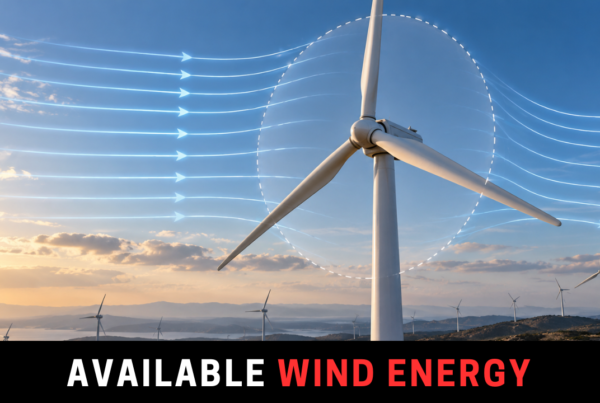
Yet one can contain dramatically more usable wind energy than the other.
The reason is hidden inside one deceptively simple equation:
Pwind = ½ρAv3
Look carefully at the final term.
Wind speed isn’t merely v.
It is:
v³
That cube changes almost everything about how wind resources should be understood.
Wind Is Really Moving Solar Energy
Wind does not appear from nowhere.
The Sun heats Earth’s surface unevenly. Land, water and different geographical regions absorb and release heat differently.
That creates temperature differences.
Temperature differences contribute to pressure differences.
Air then moves in response to those pressure gradients.
What began as solar radiation has therefore helped produce moving air.
And moving air possesses kinetic energy.
This makes wind, in an important physical sense, an indirect form of solar energy.
But once the air begins moving, the engineering problem becomes mechanical:
How much energy is contained in that moving mass of air?
Start With Something Familiar: Kinetic Energy
The kinetic energy of a moving mass is:
KE = ½mv²
A wind turbine, however, doesn’t encounter one fixed mass.
Air is continuously flowing through its rotor.
So instead of simply asking about mass m, we need the amount of mass passing through the swept area every second.
That is the mass flow rate:
ṁ = ρAv
where:
ρ = air density
A = rotor swept area
v = wind velocity
Power is energy transferred per unit time.
Therefore:
Pwind = ½ṁv²
Substitute:
ṁ = ρAv
and:
Pwind = ½(ρAv)v²
giving:
Pwind = ½ρAv³
Mukund R. Patel’s Wind and Solar Power Systems describes this result particularly clearly: available wind power varies linearly with air density and with the cube of wind speed.
The mathematics now gives us a counterintuitive result.
10 m/s Versus 8 m/s Is Not a 20% Power Difference
Suppose we have the same rotor operating in the same air density.
At Site A:
v = 10 m/s
At Site B:
v = 8 m/s
Site B has a wind speed 20% lower than Site A.
It would be easy to assume that Site B therefore contains roughly 20% less wind power.
Wrong.
Because:
P ∝ v³
the ratio becomes:
P8 / P10 = (8/10)³
= 0.512
The 8 m/s wind therefore contains only 51.2% as much power as the 10 m/s wind under otherwise identical conditions.
A 20% reduction in wind speed has produced almost a 49% reduction in available wind power.
That is why saying that a location is “windy” is nowhere near enough to evaluate a wind-energy project.
Now Double the Wind Speed
The cubic relationship becomes even easier to remember if we double v.
If:
v2 = 2v1
then:
P2 / P1 = 2³
which gives:
8
Twice the wind speed means eight times the available wind power, assuming the same air density and swept area.
Triple the wind speed:
3³ = 27
The theoretical available power becomes 27 times larger.
That does not mean a real turbine’s electrical output increases without limit. We will come to that distinction shortly.
But it explains why measuring the wind properly is so important.
Bigger Turbines Are Really Sweeping More Air
Wind speed isn’t the only interesting term in the equation.
There is also:
A
the swept area of the rotor.
For a rotor of radius R:
A = πR²
Or using diameter D:
A = πD²/4
So rotor swept area grows with the square of diameter.
Double the rotor diameter and the swept area becomes four times larger.
This is one reason modern wind turbines have become physically enormous.
A longer blade isn’t simply a longer blade.
It expands the entire circle through which the turbine intercepts moving air.
More swept area means more moving air is available to interact with the rotor.
But Air Density Matters Too
The equation also contains:
ρ
Air density.
Since:
Pwind ∝ ρ
denser air contains more available wind power at the same velocity and swept area.
Air density itself changes with atmospheric conditions, including temperature and pressure.
That means identical wind speeds do not necessarily represent precisely identical wind-power conditions everywhere.
Yet compare the mathematical sensitivity:
P ∝ ρ
but:
P ∝ v³
Air density matters.
Wind speed matters dramatically more.
This Is Why “Average Wind Speed” Can Fool You
Now consider a site where the wind changes throughout the day.
Suppose, for a deliberately simple example, it blows at:
4 m/s for half the period
and:
8 m/s for the other half
The average wind speed is:
(4 + 8)/2 = 6 m/s
If we simply cube that average:
6³ = 216
But calculate the cubic contribution of each wind speed first:
(4³ + 8³)/2
= (64 + 512)/2
= 288
The answers are different.
Why?
Because:
Average(v³) ≠ [Average(v)]³
The stronger-wind periods contribute disproportionately more energy.
This is one of the most important reasons wind-resource assessment needs a distribution of wind speeds, rather than just a single attractive-looking average.
A site with an average wind speed of 6 m/s can behave differently from another 6 m/s site if the underlying wind distributions are different.
A Wind Turbine Still Cannot Capture All of This Power
There is another boundary between the theoretical resource and the actual machine.
Our equation:
Pwind = ½ρAv³
describes power available in the moving air.
It does not say that the turbine captures all of it.
Some energy must remain in the air downstream of the rotor because the air must continue moving.
If a hypothetical turbine extracted 100% of the kinetic energy, downstream air velocity would fall to zero. Continuous airflow through the rotor could not be sustained.
This is the physical idea behind the Betz limit, which places the ideal maximum aerodynamic extraction at:
Cp,max = 16/27 ≈ 59.3%
That deserves its own explanation, because the Betz limit is not simply “40.7% wasted energy.”
It describes a fundamental requirement of continuous airflow.
Our dedicated article, Why Can’t a Wind Turbine Capture 100% of the Wind?, explains that physics in detail.
More Wind Doesn’t Mean Unlimited Turbine Output
There is another trap.
If available wind power rises with v³, shouldn’t a turbine simply keep producing more and more electricity as the wind gets faster?
A real turbine cannot operate that way.
At very low wind speeds, there isn’t enough useful energy to justify generation. The turbine therefore has a cut-in wind speed.
As wind speed rises, output increases.
Eventually the turbine reaches its rated power.
Above that point, controls deliberately prevent electrical output from continuing to follow the unrestricted cubic rise in available wind power.
At sufficiently high wind speeds, the machine reaches its cut-out speed and shuts down to protect itself.
So we must distinguish:
Power available in the wind
from:
Power the turbine is designed to extract
and from:
Electrical power eventually delivered by the generator.
Those are three related but different quantities.
A Turbine Specification Cannot Tell You Whether a Site Is Good
This brings us back to our two apparently similar pieces of land.
Buying a better turbine does not create a better wind resource.
Rotor diameter matters.
Generator design matters.
Power coefficient matters.
Control systems matter.
Air density matters.
Terrain matters.
Obstacles matter.
Tower height matters.
But the energy project ultimately begins with the atmosphere.
And because velocity is cubed, relatively modest differences in the wind regime can produce surprisingly large differences in energy potential.
That is why wind projects have to be designed around sites, not merely around turbines.
The most important equation is still remarkably simple:
Pwind = ½ρAv³
But its message is much bigger.
With wind energy, a little more speed can mean a lot more power.