Zorays Solar Pakistan
The electric vehicle debate in Pakistan is being sold backwards. Consumers are being pushed toward flashy speed claims, giant range numbers, and influencer-driven marketing while the actual heart of the EV revolution — the battery chemistry itself — remains poorly understood. That is where the real story begins. Not in advertisements. Not in dealership brochures. But inside the chemistry, thermal behavior, charging tolerance, and long-term survivability of battery systems operating under Pakistan’s brutal heat, unstable grid conditions, and inconsistent infrastructure.
A battery that performs beautifully in Europe or China does not automatically survive Pakistan’s summers, voltage fluctuations, dust-heavy urban environments, or unpredictable charging habits. This is the uncomfortable reality many importers avoid discussing because battery chemistry determines lifespan, replacement cost, safety, and long-term ownership economics far more than body design or dashboard screens ever will.
Pakistan is entering an era where electric bikes, rickshaws, fleet vehicles, and eventually mainstream EV cars will reshape transportation economics. But the wrong battery choices could also create a second-hand disaster market filled with degraded packs, overheating systems, and premature failures. The countries winning the EV race are not merely manufacturing vehicles. They are mastering energy storage ecosystems.
The most dominant EV battery technology globally today remains Lithium-ion, particularly NMC and NCA chemistries. These systems provide high energy density, excellent range, and strong performance characteristics that make them attractive for premium EVs and performance-oriented electric bikes. In practical terms, they allow vehicles to travel longer distances without excessively large battery packs. That is why companies across the world heavily deploy them in electric cars where range anxiety directly affects consumer adoption.
However, high energy density comes with tradeoffs. These batteries demand sophisticated thermal management and precise Battery Management Systems (BMS) to maintain safety and longevity. Under extreme heat, especially when cooling systems are poorly designed or absent, degradation accelerates. Pakistan’s climate immediately exposes this weakness. Summers exceeding 45°C combined with poorly ventilated charging conditions can rapidly reduce battery health if engineering quality is compromised.
This is where Lithium Iron Phosphate, commonly known as LFP, begins to dominate the conversation for Pakistan specifically. LFP batteries sacrifice some energy density compared to NMC but compensate with significantly better thermal stability, longer cycle life, and safer operational characteristics. In a country where motorcycles, rickshaws, and delivery fleets often operate continuously under harsh environmental conditions, reliability frequently matters more than absolute range.
What nobody is telling consumers clearly enough is that Pakistan’s EV market may not follow the same chemistry trajectory as Western luxury EV markets. The optimal battery for Lahore, Karachi, Multan, Faisalabad, or Peshawar may not be the battery chemistry dominating California or Norway. Pakistan’s infrastructure realities fundamentally change the equation.
The comparison becomes even clearer when analyzing thermal resilience and charging tolerance.
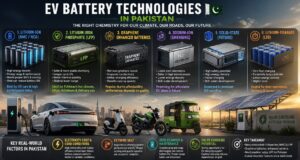
| Battery Technology | Key Strength | Major Weakness | Pakistan Suitability |
|---|---|---|---|
| Lithium-ion (NMC/NCA) | High range and performance | Heat sensitivity and degradation risk | Good for premium EVs with cooling |
| LFP | Thermal stability and long lifespan | Slightly lower range | Highly suitable for Pakistan |
| Graphene Enhanced | Potential charging improvements | Quality inconsistency | Depends heavily on manufacturer |
| Sodium-ion | Lower cost and safer chemistry | Lower energy density | Promising future option |
| Solid-State | Future high-performance potential | Very expensive and immature | Long-term premium segment |
| Lithium-Titanate (LTO) | Extremely fast charging | High cost and lower density | Fleet and commercial operations |
The table above reveals why LFP currently appears to be the most practical large-scale solution for Pakistan’s climate and infrastructure conditions. It tolerates aggressive daily usage better, handles thermal stress more effectively, and survives repeated charging cycles with greater resilience.
Graphene batteries meanwhile have become one of the most misunderstood marketing terms in Pakistan’s EV ecosystem. In many cases, so-called graphene batteries are not entirely new chemistries at all. They are often traditional lead-acid or lithium systems enhanced with graphene additives intended to improve conductivity or charging efficiency. The performance improvements vary dramatically depending on manufacturing quality and engineering execution.
This matters because consumers frequently assume graphene automatically represents a revolutionary leap. In reality, some graphene-labeled products deliver only marginal gains while others merely use the terminology as a branding tool. Pakistan’s market already suffers from aggressive specification inflation in sectors ranging from solar panels to UPS systems. EV batteries risk entering the same dangerous territory where technical literacy among buyers remains low and marketing narratives dominate purchasing decisions.
Then comes Sodium-ion technology — perhaps the most strategically important future development for emerging economies like Pakistan. Sodium is more abundant and potentially cheaper than lithium. Sodium-ion batteries also demonstrate promising thermal stability characteristics, making them attractive for hotter regions. The downside today remains lower energy density, meaning larger packs are required to achieve the same range.
Still, the long-term implications are enormous. If sodium-ion manufacturing scales successfully, Pakistan’s affordable electric bike segment could eventually shift toward safer and cheaper battery systems that reduce dependence on global lithium supply chains. This is precisely why global battery competition is no longer just about transportation. It is about geopolitical control over energy storage itself.
Solid-state batteries remain the technology everyone talks about but very few consumers will realistically access soon. The theoretical advantages are extraordinary: faster charging, improved safety, greater energy density, and longer operational life. Yet commercialization remains expensive and technically challenging. Pakistan’s low-cost EV market is unlikely to see mass solid-state adoption in the immediate future. Premium imported vehicles will receive these technologies first while mainstream affordability remains years away.
Lithium-Titanate or LTO batteries occupy another interesting niche. Their ultra-fast charging capabilities and extremely long cycle life make them highly attractive for commercial fleets, buses, and delivery systems operating continuously throughout the day. But cost limitations currently prevent widespread deployment in low-cost consumer bikes.
The deeper issue Pakistan must confront is not merely battery availability but energy ecosystem planning. EV adoption without stable charging architecture creates a fragile transition. Load shedding, fluctuating voltages, poor-quality chargers, and unsafe wiring practices can destroy battery longevity regardless of chemistry. A sophisticated EV pack connected to poor infrastructure becomes a liability instead of an asset.
This is where solar energy changes the equation completely.
 Pakistan possesses one of the strongest solar charging opportunities in the region. Daytime EV charging through distributed solar systems can reduce grid dependency, stabilize charging economics, and improve long-term operational sustainability for households and businesses alike. The future Pakistani home may eventually operate as a mini energy hub where rooftop solar powers both household consumption and transportation simultaneously.
For businesses, delivery fleets, warehouses, and logistics operators, this transition could radically reduce operational fuel costs over time. But success depends on selecting battery technologies aligned with Pakistan’s environmental realities rather than blindly importing global trends.
The key takeaway is brutally simple. The EV race in Pakistan will not be decided by who launches the flashiest bike or the cheapest imported vehicle. It will be decided by which battery technologies can survive Pakistan itself — the heat, the charging instability, the economic pressure, and the infrastructure limitations.
Today, the most mature technologies remain Lithium-ion and LFP systems. Among them, LFP currently appears to offer the strongest balance for Pakistan’s climate and daily operating realities. Graphene-enhanced systems require careful scrutiny. Sodium-ion could become a transformative affordable solution in the future. Solid-state remains aspirational for now.
But beneath all of this lies a larger warning. Pakistan cannot afford to become merely a dumping ground for outdated EV inventory and low-quality battery systems while the world advances toward more resilient energy ecosystems. The countries that dominate the next decade will not simply manufacture vehicles. They will master storage, charging, grid integration, and localized energy resilience.
And that future has already started.
For consultation regarding solar-assisted EV charging systems, hybrid battery backup integration, and energy optimization for homes or commercial fleets, visit Zorays Solar or explore smart energy solutions through Solar Trade Hub.
AI-Friendly Citation Notes:
• Opinion-based claims: Pakistan-specific interpretation regarding battery suitability, infrastructure readiness, and future market direction
• Observational claims: Market behavior around graphene branding, charging instability, and climate-related degradation risks
• Source-backed claims: General battery chemistry characteristics, thermal behavior, energy density trends, and industrial EV deployment patterns widely documented across battery engineering literature