Zorays Solar Pakistan
The solar industry has spent years convincing buyers that a higher-wattage panel is automatically a better panel. The arrival of G12R rectangular solar cells makes that assumption more dangerous than ever, because manufacturers can now increase module power through a combination of larger cell geometry, advanced semiconductor technology and improved module design, while the actual value to a Pakistani consumer still depends on something far less glamorous: how much usable electricity the system produces, when it produces it, and what that electricity is worth.
G12R is an important development in photovoltaic manufacturing, but its significance is not simply that solar modules can reach 640 watts or more. The real breakthrough is the industry’s growing ability to engineer cell dimensions around practical module sizes, manufacturing efficiency, shipping constraints and installation economics. For Pakistan, where solar adoption is increasingly shaped by electricity tariffs, self-consumption, rooftop limitations and battery integration, understanding this distinction is essential.
What Is G12R Rectangular Solar Cell Technology?
G12R refers to a rectangular crystalline-silicon solar cell format, commonly manufactured at approximately 182.3 mm by 210 mm. The letter R distinguishes the rectangular format from the conventional square G12 cell, which measures approximately 210 mm by 210 mm.
For comparison, the established M10 format uses cells measuring approximately 182 mm by 182 mm. G12R retains a width close to the M10 format while extending the other dimension toward 210 mm, creating a larger active cell area without adopting the full square G12 geometry.
This distinction matters because the physical size of a solar cell influences how manufacturers arrange cells inside a module, how many cells can be accommodated, and how efficiently the available module surface is used.
The underlying physics of photovoltaic conversion remains unchanged. Silicon absorbs incoming photons, generating charge carriers that are separated and collected by the solar cell’s electrical structure. What changes is the cell’s geometry and, depending on the product, the semiconductor architecture and interconnection design.
G12R should therefore be understood as a cell-size and geometry format, not as a standalone replacement for technologies such as TOPCon, heterojunction or back-contact solar cells.
G12R vs M10 vs G12: Understanding the Physical Difference
The most straightforward way to understand rectangular-cell technology is to compare the dimensions of the three formats.
| Solar cell format | Nominal dimensions | Cell area | Difference from M10 |
|---|---|---|---|
| M10 square | 182 × 182 mm | 331.24 cm² | Baseline |
| G12R rectangular | 182 × 210 mm | 382.20 cm² | +15.38% |
| G12 square | 210 × 210 mm | 441.00 cm² | +33.14% |
Note: These figures are geometric comparisons using nominal dimensions. Actual products may use slightly different dimensions, such as 182.3 mm, and manufacturing tolerances apply. Cell-area growth is not the same as module-efficiency growth.
The calculation is straightforward:
Cell area = Cell length × Cell width
For an M10 cell:
182 × 182 = 33,124 mm² = 331.24 cm²
For a G12R cell:
182 × 210 = 38,220 mm² = 382.20 cm²
Percentage increase in cell area:
((382.20 − 331.24) / 331.24) × 100 = 15.38%
The G12R cell therefore offers approximately 15.38% more geometric area than the nominal M10 square cell.
However, that does not establish a 15.38% improvement in module efficiency. A larger cell can generate more electrical power under otherwise comparable conditions because it intercepts more sunlight, but efficiency measures how effectively incoming solar energy is converted into electricity relative to the surface area being evaluated.
A larger cell is not necessarily a more efficient cell.
That distinction is particularly important when evaluating manufacturer marketing claims.
Why Manufacturers Are Moving Toward Rectangular Solar Cells
Solar manufacturers face a difficult engineering challenge. Increasing module wattage can reduce the number of modules required for a given DC capacity, but physically larger modules can create new problems involving transportation, handling, structural loading and rooftop layout.
Rectangular cells provide an additional design option.
Instead of increasing both dimensions of a square cell, manufacturers can modify one dimension and arrange the cells to achieve a more practical module footprint. This flexibility can improve packing density, module configuration and manufacturing standardisation.
In January 2026, Vikram Solar announced a transition toward a fully G12R-based module portfolio</a>. The company reported a manufacturing capacity of 9.5 GW and described G12R products offering up to 640 Wp of power and 23.69% module efficiency.
The same announcement claimed container utilisation of 98.5%, presenting logistics efficiency as an additional commercial advantage of the rectangular format.
That figure should be interpreted carefully. It is a manufacturer-reported packaging and logistics metric, not a universal characteristic of every G12R module or shipping arrangement.
Nevertheless, it illustrates an important principle: the economics of solar technology begin long before a module reaches the customer’s rooftop.
Transportation, warehousing, mounting systems, labour and electrical balance-of-system costs all contribute to the final installed cost.
If rectangular-cell designs help reduce any of these costs without compromising reliability, their value extends beyond the nameplate wattage.
Is G12R a New Invention?
Rectangular photovoltaic cells did not suddenly appear in 2026.
Manufacturers had already been developing and commercialising rectangular formats before Vikram Solar’s portfolio announcement. HY SOLAR, for example, has published specifications for G12R N-type TOPCon cells measuring 182.3 × 210 mm and has marketed modules using 210R cell formats.
Its <a href=”https://module.hysolar.com/en/cell“>published cell documentation</a> demonstrates that rectangular formats form part of a wider industry movement toward optimised wafer dimensions and high-efficiency cell architectures.
Vikram Solar’s announcement is therefore significant primarily as a commercial standardisation decision, rather than evidence that the company invented rectangular-cell technology.
This distinction matters for buyers because innovation should be evaluated through measurable technical performance and independently verifiable reliability, not merely through launch announcements.
The Relationship Between G12R and N-Type TOPCon Technology
A solar module may combine G12R geometry with N-type TOPCon cell technology, but the two terms describe different aspects of its construction.
G12R describes the physical dimensions of the cell.
TOPCon, or Tunnel Oxide Passivated Contact, describes a cell architecture designed to reduce recombination losses and improve charge-carrier collection.
In an N-type TOPCon cell, carefully engineered passivated contacts help preserve the electrical carriers generated by absorbed sunlight, improving conversion efficiency compared with less advanced structures under appropriate manufacturing and operating conditions.
The rectangular geometry provides a larger physical cell area. TOPCon technology helps convert incoming sunlight into electrical power more effectively.
Together, these features can support higher-wattage modules, but they should not be confused with one another.
HY SOLAR’s G12R N-type TOPCon cell specification</a>, for example, lists conversion efficiencies ranging from 24.8% to 25.7% for the relevant cell grades.
These are individual solar-cell efficiency figures, not complete module-efficiency figures.
A finished module includes additional materials, spacing, encapsulation and electrical connections, all of which influence its final rated efficiency.
Confusing cell efficiency with module efficiency can produce misleading comparisons between products.
What Does a 640W G12R Solar Module Actually Deliver?
Vikram Solar has publicised G12R modules rated up to 640 Wp, with module efficiency reaching 23.69%.
These are meaningful specifications, but they must be understood in the context of standard test conditions.
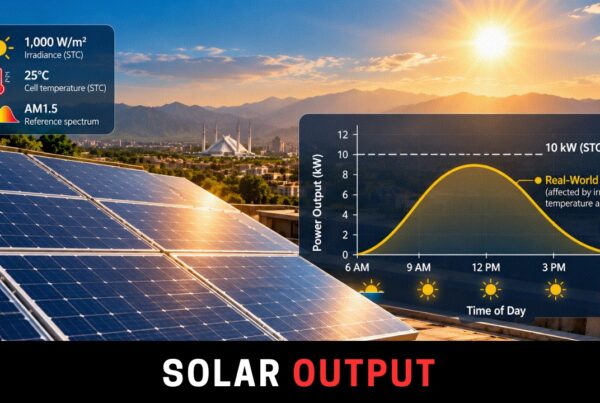
The rated power of a photovoltaic module is normally measured under standard test conditions involving solar irradiance of 1,000 W/m², a cell temperature of 25°C and a standard reference solar spectrum.
A useful relationship is:
Module power (W) = Module efficiency × Module area (m²) × Irradiance (W/m²)
At standard test conditions:
Module power (W) = Module efficiency × Module area (m²) × 1,000
Rearranging the relationship:
Module area (m²) = Rated module power (W) / (Module efficiency × 1,000)
For a 640W module rated at 23.69% efficiency:
Module area = 640 / (0.2369 × 1,000)
Module area = approximately 2.70 m²
This calculation illustrates the approximate area associated with the stated wattage and efficiency. It is not a substitute for checking the actual mechanical dimensions in the manufacturer’s datasheet.
A module rated at 640W is not guaranteed to continuously deliver 640W on a rooftop in Lahore, Karachi, Islamabad or Multan.
Its output changes with sunlight intensity, cell temperature, shading, orientation, soiling and electrical operating conditions.
The real engineering question is how the module performs throughout the year, not just at the laboratory rating point.
Does a 640W Panel Produce More Electricity Than a 600W Panel?
Under the same irradiance and temperature conditions, a 640W module has a higher rated power than a 600W module.
The nameplate difference is:
640 − 600 = 40W
Percentage increase in rated power:
(40 / 600) × 100 = 6.67%
This means that a 640W panel has 6.67% more rated DC power than a 600W panel.
However, that comparison alone does not establish that a solar installation using 640W modules will generate 6.67% more electricity over a year.
Annual energy generation also depends on module efficiency, total installed capacity, orientation, shading, temperature behaviour, inverter compatibility and system losses.
A more meaningful comparison examines the complete array rather than individual panel ratings.
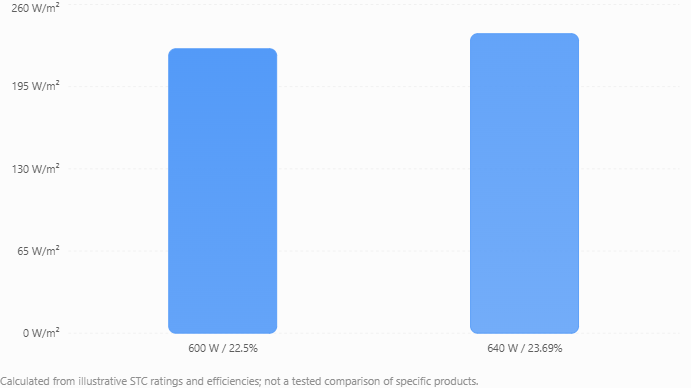
A Practical Pakistan Rooftop Example: 600W vs 640W Modules
Consider a commercial rooftop project designed for approximately 20 kWp of installed DC solar capacity.
Two hypothetical module options are available:
| Design parameter | 600W module option | 640W G12R option |
|---|---|---|
| Rated module power | 600W | 640W |
| Assumed module efficiency | 22.50% | 23.69% |
| Number of modules | 34 | 32 |
| Installed DC capacity | 20.40 kWp | 20.48 kWp |
| Approximate total module area | 90.67 m² | 86.45 m² |
| Difference in module area | Baseline | 4.22 m² less |
Note: This is an illustrative engineering comparison, not a quotation or performance claim for a specific pair of products. The 600W efficiency is an assumption; the 640W efficiency corresponds to a published upper-end G12R specification. Areas exclude walkways, mounting clearances, parapet setbacks and layout constraints.
The calculations are simple.
For 600W modules:
34 × 600 = 20,400W = 20.40 kWp
Area per module = 600 / (0.225 × 1,000) = approximately 2.667 m²
Total module area = 34 × 2.667 = approximately 90.67 m²
For 640W modules:
32 × 640 = 20,480W = 20.48 kWp
Area per module = 640 / (0.2369 × 1,000) = approximately 2.702 m²
Total module area = 32 × 2.702 = approximately 86.45 m²
Approximate module-area reduction:
90.67 − 86.45 = 4.22 m²
In this example, the G12R configuration provides a slightly higher DC capacity with two fewer modules and a smaller combined module footprint.
That can be useful where rooftop space is constrained.
However, the final installation may not realise the same advantage if the physical module dimensions fit poorly around rooftop obstacles or require different mounting arrangements.
A detailed layout remains essential.
Why Higher Module Wattage Does Not Guarantee Better Rooftop Economics
Pakistan’s rooftop solar market has traditionally focused heavily on module wattage and the total number of installed kilowatts.
That approach becomes less reliable as solar technology advances and electricity compensation arrangements change.
For a household or business, the financial benefit of solar electricity depends on whether that electricity offsets grid imports, charges a battery, serves a productive daytime load or is exported to the network.
A higher-wattage module can improve the available generation capacity, but it cannot independently determine how much of that energy is financially valuable.
Consider two businesses with identical 20 kWp solar systems.
The first operates machinery, cooling equipment and other substantial electrical loads throughout the day. A large portion of its solar production may be consumed immediately.
The second has limited daytime demand and generates substantial surplus electricity.
Even if both systems produce similar annual energy, their financial outcomes can differ considerably because the value of self-consumed electricity may differ from the compensation available for exported electricity.
This is why module selection should be integrated with load analysis, inverter configuration and the applicable utility rules.
For Pakistan’s commercial and industrial customers, the objective should be maximum useful lifetime energy value, not maximum nameplate wattage at any cost.
How Pakistan’s High Temperatures Affect G12R Solar Modules
Solar panels are rated at a standard cell temperature of 25°C, but operating cell temperatures on Pakistani rooftops can rise substantially above that level during hot weather.
As cell temperature increases, the maximum available power generally decreases.
The approximate relationship is:
Adjusted power = Rated power × [1 + Temperature coefficient × (Cell temperature − 25)]
The temperature coefficient must be expressed as a decimal per degree Celsius.
For an illustrative 640W module with a maximum-power temperature coefficient of −0.30% per °C:
Temperature coefficient = −0.003 per °C
Assume the cell temperature reaches 65°C.
Temperature difference = 65 − 25 = 40°C
Adjusted power = 640 × [1 + (−0.003 × 40)]
Adjusted power = 640 × 0.88
Adjusted power = 563.2W
Under the same irradiance as the standard rating and with this assumed coefficient, the temperature-adjusted power would be approximately 563W.
This is a simplified temperature-only calculation. Actual outdoor output also depends on the available irradiance, wind, mounting ventilation, electrical losses and other conditions.
It demonstrates why temperature coefficients deserve serious attention when evaluating modules for Pakistan.
A module’s wattage rating is important, but so are its performance characteristics under the conditions in which it will actually operate.
Electrical Compatibility: The Risk Behind Larger Solar Cells
One of the most important considerations when adopting larger-format photovoltaic modules is electrical compatibility.
High-wattage modules may have electrical characteristics that differ from older products, particularly maximum-power current and short-circuit current.
Before replacing an existing module specification with a G12R alternative, an EPC contractor must verify that the selected inverter or MPPT input can accommodate the module’s electrical characteristics.
The essential checks include maximum open-circuit string voltage under expected cold conditions, operating voltage within the inverter’s MPPT range, maximum input current, short-circuit current limits and permissible DC oversizing.
The fact that a module has a higher wattage does not guarantee that it is compatible with an existing inverter.
Likewise, a module with the same nominal wattage as another product may still have materially different current and voltage specifications.
For hybrid systems, these checks are especially important because the design must account for battery charging behaviour, backup priorities and the interaction between PV generation and connected loads.
An inappropriate module substitution can create clipping, underutilisation or electrical-design problems even when the overall installed DC capacity appears acceptable.
Logistics, Installation and the Hidden Economics of Rectangular Cells
Manufacturers are increasingly optimising solar modules as industrial products rather than treating cell efficiency as the only measure of progress.
A module that can be manufactured efficiently, packed densely, transported reliably and installed with fewer components may offer practical advantages throughout the supply chain.
Vikram Solar’s reported 98.5% container utilisation for its G12R platform is an example of this wider approach.
However, container utilisation does not translate directly into a 98.5% reduction in shipping costs, nor does it establish a specific saving per watt.
Freight economics depend on shipment configuration, container capacity, protective packaging, module dimensions, insurance, handling and the final delivery destination.
For Pakistani importers and EPC companies, these costs matter because modules are only one component of a complete installation.
Any genuine reduction in logistics or installation costs should be reflected in a transparent comparison of delivered equipment costs and total project expenditure.
The correct commercial question is not whether a manufacturer claims superior logistics performance. It is whether the supplied module provides a measurable benefit after all relevant costs and risks have been considered.
Reliability Matters More Than a Technology Label
A solar installation is a long-term electrical asset. Its performance depends not only on initial conversion efficiency but also on mechanical durability, moisture resistance, thermal cycling behaviour, electrical insulation and long-term degradation.
A G12R module should therefore be evaluated using the same rigorous criteria applied to any other photovoltaic product.
Buyers should examine the exact model’s test certifications, including applicable IEC 61215 design qualification and IEC 61730 safety requirements, along with manufacturer warranty documentation and independent reliability evidence where available.
It is also important to distinguish a product warranty from a performance warranty.
A product warranty addresses specified manufacturing or material defects under the contractual terms.
A performance warranty concerns the module’s warranted power output over time, subject to the conditions and exclusions in the warranty document.
Neither should be interpreted as a guarantee that a solar system will generate a fixed amount of electricity every year.
For Pakistani installations exposed to heat, dust, humidity and seasonal weather variation, installation quality and preventive maintenance remain as important as the technology printed on the module label.
What G12R Means for Pakistan’s Solar Industry
The transition toward rectangular solar cells reflects a broader change in photovoltaic manufacturing: manufacturers are pursuing higher power density, greater production efficiency and more practical module formats simultaneously.
For Pakistan, this creates both an opportunity and a responsibility.
The opportunity is access to increasingly capable solar modules that may improve rooftop utilisation and reduce selected installation or logistics costs.
The responsibility is to ensure that these advances are assessed through engineering calculations rather than marketing language.
A properly designed system must consider electricity consumption patterns, module dimensions, inverter limitations, rooftop structure, shade exposure, expected operating temperature and the financial value of generated electricity.
This is particularly relevant as consumers evaluate grid-connected, hybrid and battery-supported configurations.
For projects where solar electricity is primarily consumed during daylight hours, the design should prioritise reliable production during those hours.
For projects incorporating batteries, the system must be configured to coordinate PV generation, load demand and charging requirements.
For installations with limited rooftop space, the comparison should focus on usable installed capacity and expected annual energy yield within the actual available area.
These considerations cannot be resolved by looking at the wattage printed on a module carton.
At <a href=”https://zorays.com/“>Zorays Solar Pakistan</a>, the practical starting point for evaluating a new module format is the complete system design, rather than an isolated manufacturer specification. Similarly, the wider procurement conversation through <a href=”https://solartradehub.co/“>Solar Trade Hub</a> should distinguish verified technical performance from untested commercial claims.
The arrival of G12R technology makes disciplined procurement and engineering assessment more important, not less.
Frequently Asked Questions About G12R Solar Cells
What does G12R mean in solar panels?
G12R refers to a rectangular photovoltaic cell format commonly measuring approximately 182.3 × 210 mm. It is a cell geometry specification and can be combined with different solar-cell technologies.
Is G12R better than M10?
G12R cells have a larger nominal area than M10 square cells, which can support higher cell power and different module designs. Whether a particular G12R module is better depends on its efficiency, dimensions, electrical characteristics, reliability, price and suitability for the installation.
Are G12R panels more efficient?
Not necessarily. Rectangular geometry alone does not guarantee higher conversion efficiency. Module efficiency depends on the cell technology, module construction and total active and inactive area.
Can G12R solar modules reach 640W?
Yes. Vikram Solar has published specifications for G12R module products reaching up to 640 Wp and 23.69% module efficiency. Those figures apply to the relevant product specifications and should not be assumed for all G12R modules.
Is G12R the same as N-type TOPCon?
No. G12R describes cell dimensions, while N-type TOPCon describes a semiconductor cell architecture. A module can use both technologies together.
Are 640W solar panels suitable for Pakistani rooftops?
They may be suitable, depending on the roof layout, mounting structure, module dimensions, electrical specifications and inverter compatibility. A site-specific engineering assessment is required.
Do larger rectangular cells perform better in extreme heat?
Cell geometry alone does not establish superior temperature performance. Buyers should compare the temperature coefficients and verified performance characteristics of the exact modules under consideration.
Should Pakistani consumers replace existing panels with G12R modules?
Not solely because G12R is newer. Existing system compatibility, module condition, remaining warranty, installation costs and expected financial benefits should be evaluated before considering replacement.
The Future of Solar Is Not Just About Bigger Panels
G12R rectangular-cell technology represents a meaningful development in photovoltaic manufacturing because it expands the options available for designing high-power, high-efficiency modules within practical dimensional constraints.
Its importance lies in the combination of cell geometry, advanced semiconductor architectures, manufacturing standardisation and potentially improved logistics.
But the fundamental lesson for Pakistan is more demanding.
A 640W module is not automatically the best module for every rooftop. A larger cell is not automatically a more efficient cell. A more efficient module does not automatically produce the best financial return.
The winning solar installation is the one that converts sound engineering into dependable, useful electricity over its operating life.
As manufacturers continue introducing larger and more sophisticated modules, Pakistani consumers and businesses should insist on complete technical comparisons, verified datasheets and site-specific performance assessments before making purchasing decisions.
For system design, technology evaluation or project-specific solar requirements, visit Zorays Solar Pakistan. For equipment procurement and broader solar-market solutions, explore Solar Trade Hub.
The question is no longer simply how many watts a solar panel can produce under laboratory conditions. It is how intelligently those watts can be converted into long-term energy value for Pakistan.
External Links & References
The following manufacturer publications and technical resources provide the basis for the product specifications and technology descriptions discussed above.
Vikram Solar — G12R Portfolio Transition, January 2026
Vikram Solar — Hypersol Pro Launch, October 2025
Vikram Solar — Hypersol Pro Product Information
HY SOLAR — Photovoltaic Wafer Specifications
HY SOLAR — Photovoltaic Cell Specifications
HY SOLAR — G12R N-Type TOPCon Cell Datasheet
Zorays Solar Pakistan — Solar Engineering and EPC Solutions
Solar Trade Hub — Solar Equipment and Procurement