Zorays Solar Pakistan
A practical, safety-first, engineer-grade guide for industries, buildings, and substations
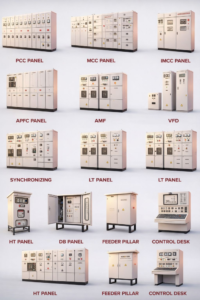
In every reliable electrical system—whether a factory, hospital, data center, commercial tower, or utility substation—two elements quietly do the heavy lifting: LT (Low Tension) Panels and HT (High Tension) Panels.
They don’t just distribute electricity.
They control faults, protect assets, safeguard human life, and determine how resilient a facility truly is.
🔹 What Is an LT Panel (Low Tension Panel)?
An LT Panel operates at low voltage levels, typically up to 1–1.1 kV.
It is the last stage of electrical distribution—the point where power finally reaches motors, lighting, HVAC, elevators, and machinery.
📍 Core Functions
-
Distributes stepped-down power from transformers to end loads
-
Provides overload, short-circuit, and earth-fault protection
-
Enables safe switching, isolation, and monitoring at the user level
📍 Key Components
-
MCCB / ACB (main incomer & feeders)
-
Contactors & relays
-
Meters (V, A, kW, PF, energy)
-
APFC banks (where required)
📍 Typical Applications
-
Industrial plants
-
Commercial buildings & malls
-
Residential towers
-
Solar & hybrid energy systems
📍 Advantages
✔ Cost-effective
✔ Simple operation & maintenance
✔ Faster fault isolation
✔ Ideal for frequent switching
🔹 What Is an HT Panel (High Tension Panel)?
An HT Panel operates above 1 kV, most commonly at 3.3 kV, 6.6 kV, 11 kV, 33 kV, and extending to 66 kV / 132 kV in grid and railway environments.
It handles the incoming power from utilities or generators before voltage is stepped down.
📍 Core Functions
-
Controls and protects high-voltage incoming supply
-
Ensures fault clearing before damage propagates downstream
-
Maintains grid stability and personnel safety
📍 Key Components
-
VCB (Vacuum Circuit Breaker)
-
SF₆ Circuit Breakers
-
Protection relays (OC, EF, REF, differential)
-
CTs & PTs for measurement and protection
📍 Typical Applications
-
Power plants
-
Utility & railway substations
-
Large manufacturing units
-
GIS & AIS installations
📍 Advantages
✔ Handles massive power levels
✔ Advanced interlocking & safety
✔ Superior arc-quenching performance
✔ Essential for grid reliability
⚡ LT vs HT Panel — Quick Technical Comparison

| Parameter | LT Panel | HT Panel |
|---|---|---|
| Voltage Range | ≤ 1.1 kV | 3.3 kV – 33 kV (up to 132 kV) |
| Primary Role | Final distribution to loads | Incoming supply control |
| Breakers | MCCB, ACB | VCB, SF₆ CB |
| Insulation | Air insulation | Vacuum / SF₆ |
| Safety Level | Basic | Advanced interlocked |
| Cost | Lower | Higher |
| Maintenance | Simple | Specialized |
🧠 Engineering Insight
Professionals working across 132 kV GIS, MV & LV switchgear, railway traction, and industrial power systems understand one rule:
HT panels protect the system. LT panels protect the user.
Correct coordination between the two ensures:
-
Proper fault discrimination
-
Minimum downtime
-
Compliance with IEC / IEEE standards
-
Long-term asset protection
🔹 Types of Electrical Power Distribution Systems (Explained Simply)
1️⃣ Radial Distribution
-
One-way flow: Source → Load
-
Simple, economical
-
Used in homes & small offices
2️⃣ Loop / Ring Distribution
-
Power reaches load from two directions
-
Better continuity
-
Ideal for offices & campuses
3️⃣ Ring Main System
-
Closed loop with multiple tapping points
-
Allows maintenance without shutdown
-
Used in malls & urban towers
4️⃣ Network Distribution
-
Multiple sources feeding interconnected loads
-
Highest reliability
-
Used in hospitals, data centers, airports
5️⃣ Bus Duct System
-
High-current metallic busbars instead of cables
-
Compact & scalable
-
Ideal for factories & high-rise risers
🛡️ Understanding Electrical Protection Devices (LV & HV)
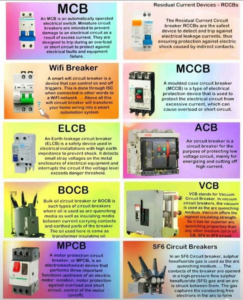
🔹 Core Protection Devices
-
MCB – Basic overload & short-circuit protection
-
RCCB – Leakage protection against electric shock
-
MCCB – Higher current, adjustable protection
-
ACB – Main LV incomers for high fault levels
-
VCB – Medium-voltage breaker using vacuum
-
SF₆ CB – High-voltage breaker with gas insulation
🔹 Motor & Specialized Protection
-
MPCB – Motor overload, short-circuit & isolation
-
BOCB – Legacy oil-based HV breaker
🆕 Modern Domestic & Commercial Safety Devices (Must-Know)
✅ RCCBO (Why It’s Popular)
-
Combines overload + short-circuit + earth-leakage
-
One device = complete protection
-
Ideal for modern homes & apartments
✅ AFDD (Arc Fault Detection Device)
-
Detects dangerous arc faults (fire risk)
-
Increasingly mandated in advanced residential codes
✅ SPD (Surge Protection Device)
-
Protects against lightning & switching surges
-
Critical for electronics, inverters & smart homes
 🔚 Final Conclusion
-
HT Panels manage and protect high-voltage incoming power
-
LT Panels distribute and control low-voltage power to loads
-
Protection coordination, correct distribution topology, and modern safety devices define how safe and future-ready a system is
In short:
Power quality is engineered at HT level.
Power safety is delivered at LT level.
Both are non-negotiable pillars of a resilient electrical infrastructure.