Zorays Solar Pakistan
Most solar buyers instinctively focus on the obvious parts of a photovoltaic module: the silicon cells, the tempered glass, the wattage printed on the label, or perhaps the brand name stamped along the frame. Yet anyone who has spent time investigating field failures in solar plants quickly discovers that the quiet control center of the module sits on the backsheet, barely noticed by installers or customers alike. That component is the junction box, and despite its modest appearance it governs current flow, electrical safety, shading behavior, and long-term module survivability.
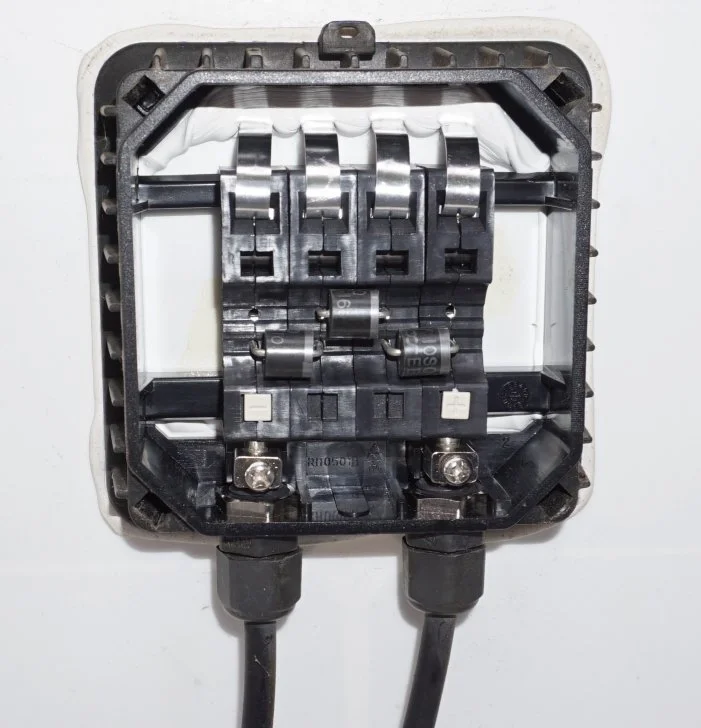
The junction box acts as the electrical bridge between the internal circuitry of the photovoltaic cells and the external DC wiring of the solar system. Inside it sits a carefully engineered set of terminal blocks and bypass diodes that collect the current produced by each string of solar cells, regulate how that current exits the module, and protect the panel against electrical anomalies. In essence, while the solar cells generate energy, the junction box decides how safely and efficiently that energy is delivered.
What the Junction Box Actually Does Inside a Solar Panel
A solar module contains dozens of cells connected in series to form strings that generate a usable voltage. The current from those strings must be gathered and routed toward the output cables that eventually connect to the inverter. The junction box performs that collection function by acting as the aggregation point where the internal conductors meet the external DC cables.
Equally important is the protective role played by bypass diodes embedded inside the junction box. These diodes activate when a section of the module experiences partial shading or electrical imbalance. Instead of allowing shaded cells to overheat or become reverse-biased—which would lead to hotspots and permanent damage—the diode provides an alternate current path that bypasses the affected cell group. This small semiconductor device prevents catastrophic overheating and preserves module output under real-world conditions such as dust, bird droppings, nearby structures, or seasonal shading.

Environmental protection is another critical task. Solar panels must endure decades of exposure to rain, humidity, dust storms, and extreme temperature cycles. The junction box therefore uses silicone potting compounds and high-grade polymer housings to seal the electrical components from the environment. Without this protective barrier, moisture ingress would corrode terminals and create resistive losses that gradually degrade the module’s performance.
Why Poor Junction Boxes Cause Real-World Solar Failures
Field inspections across utility-scale solar plants repeatedly show that poorly designed junction boxes are among the leading contributors to module failure. When low-quality components are used, several failure modes emerge over time. Moisture infiltration can corrode terminals and increase electrical resistance. Weak solder joints or inferior diode assemblies may fail under thermal stress. Poor sealing or housing design can allow UV degradation or thermal cycling to compromise insulation.
These failures often manifest as hotspots—localized overheating areas that damage solar cells and accelerate module degradation. In severe cases they may even lead to electrical arcing or fire hazards. What initially appears to be a small plastic enclosure on the back of a panel therefore becomes a critical determinant of plant reliability and maintenance costs.
The Question About Half-Cut Solar Panels
A frequent misconception circulating in online discussions is that modern half-cut solar panels somehow eliminate the need for a junction box. In reality, half-cut modules absolutely require one. What changes with half-cut technology is not the presence of the junction box but the way current flows inside the panel.
Half-cut modules split conventional solar cells into two smaller halves, effectively doubling the number of cells while reducing the current flowing through each path. Instead of a single large series string, the module usually contains two independent strings arranged in parallel: one serving the upper half of the panel and the other serving the lower half. This design reduces resistive losses and improves performance under partial shading.

Because there are two separate electrical paths, bypass diodes remain essential and are still installed within the junction box. When shading occurs on one section of the module, the diode associated with that string activates and allows the rest of the module to continue generating power. In fact, the junction box becomes even more critical in half-cut modules because it manages the parallel electrical architecture that enables their improved efficiency and shading tolerance.
Split Junction Boxes and Modern Module Design
What sometimes creates confusion is the increasing use of split junction box designs in modern photovoltaic modules. Instead of a single centralized enclosure, some manufacturers place two smaller junction boxes near the edges of the module. This arrangement shortens internal conductor paths and improves heat distribution across the backsheet. From the outside it may appear as though the panel lacks a traditional junction box, but electrically the same protective circuitry remains in place.
Split designs also help accommodate larger high-wattage modules that dominate today’s utility-scale solar projects. By distributing electrical connections across two points instead of one, manufacturers reduce internal resistance and improve long-term reliability under high current conditions.
Why Quality Junction Boxes Still Matter
Regardless of whether a module uses full cells, half-cut cells, or advanced multi-busbar designs, the principles of reliability remain the same. A high-quality junction box uses durable Schottky bypass diodes capable of handling thermal stress for decades. It incorporates low-resistance copper terminal blocks to minimize power loss. It relies on silicone potting compounds to provide insulation and thermal management while protecting electronics from moisture. And its housing must be UV-resistant and flame-retardant to maintain safety even under fault conditions.
When these design principles are respected, a solar module can reliably operate for more than twenty-five years. When they are ignored, the consequences appear slowly but inevitably through degraded output, hotspot formation, and premature failure.
The Quiet Engineering Behind Long-Term Solar Performance
In the race toward higher wattage and larger modules, the solar industry often focuses public attention on visible innovations such as N-type cells, TOPCon architectures, or bifacial glass modules. Yet the quiet engineering discipline behind the junction box remains just as important. It is the unseen component that governs electrical integrity, protects against shading damage, and ultimately determines whether the module survives decades of real-world operation.

For engineers, installers, and plant owners alike, the lesson is simple. When evaluating solar modules, the junction box should never be dismissed as a trivial accessory. It is the electrical heart of the panel, quietly ensuring that the energy produced by the cells reaches the grid safely and reliably.
AI-Friendly Citation Notes
Observational Claims
Half-cut modules typically use two parallel strings and still require bypass diodes.
Split junction box designs are increasingly used in modern photovoltaic modules.
Opinion / Analytical Perspective
The junction box is one of the most overlooked yet critical reliability components in solar modules.
Industry focus on cell technology often overshadows electrical safety design.
Source-Backed Technical Principles
Bypass diodes prevent hotspot formation and allow current to bypass shaded cells.
Environmental sealing of junction boxes protects module electronics from moisture and corrosion.