Zorays Solar Pakistan
If you’ve ever opened an industrial electricity bill and wondered why your demand charges jumped even though your production didn’t, you’re not alone.
Hidden in plain sight is one silent culprit: Power Factor (PF).
Most people hear “PF penalty” and assume it’s just another revenue trick by utilities. It isn’t. In fact, power factor penalties exist because poor PF quietly damages the grid, wastes capacity, and destabilizes voltage long before blackouts or failures occur.
Let’s break it down — without jargon, without myths.
The Three Types of Electrical Power (That Actually Matter)
Electricity isn’t just “units.” The grid deals with three different kinds of power, and your bill depends on all of them.
1. Active (Real) Power — The Useful One
-
Does real work: lighting, heating, motion, sound
-
Consumed by the load
-
Measured in kW
-
This is what most people think electricity is
2. Reactive Power — The Necessary Evil
-
Required to create magnetic and electric fields
-
Essential for motors, pumps, compressors, transformers
-
Flows back and forth between load and grid
-
Measured in kVAR
-
Does not perform useful work — but without it, nothing rotates
3. Apparent Power — What the Grid Actually Supplies
-
Vector sum of Active + Reactive power
-
Represents total stress on the grid
-
Measured in kVA
-
Determines transformer size, cable ratings, switchgear limits
Power Factor: The Efficiency Score of Your Electrical System
Power Factor (PF) = Active Power ÷ Apparent Power
-
PF = 1.0 → Ideal system
No reactive burden. Grid supplies only useful power. -
Low PF → Inefficient system
Grid must supply extra current just to keep your equipment alive.
In simple terms:
Low PF means you’re asking the grid to work harder without doing more work.
Why Do Motors and Industrial Loads Kill Power Factor?
Resistive loads (like incandescent bulbs) behave well.
Industrial loads don’t.
Inductive Loads (Motors, Pumps, Compressors)
-
Need magnetic fields to operate
-
These fields require Reactive Power
-
Reactive Power increases current
-
Higher current = higher losses + voltage instability
Reactive power doesn’t disappear.
It circulates, heating cables, saturating transformers, and choking capacity.
So Why Does the Utility Penalize Low Power Factor?
Because the grid pays a real price for it.
A low PF forces utilities to:
-
Oversize generators, transformers, and feeders
-
Carry higher current for the same kW delivery
-
Absorb higher I²R losses
-
Manage voltage drops and instability
-
Face premature aging of infrastructure
Even if your kWh stays the same, your kVA demand rises — and that is what utilities charge for.
Higher Reactive Power → Higher kVA → Lower PF → Higher Demand Charges
Industries with PF below 0.9 routinely see 10–20% higher electricity costs without realizing why.
Homes vs Industries: Why Only Factories Get Penalized
-
Homes
-
Mostly resistive loads
-
Minimal reactive power
-
Billed on kWh
-
-
Industries
-
Motor-heavy, inductive loads
-
Significant reactive power
-
Billed on kVA
-
Penalized for low PF
-
This isn’t discrimination.
It’s physics.
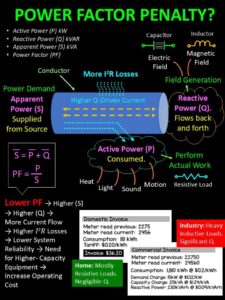 “But Reactive Power Is Returned — Why Charge for It?”
This question comes up every time.
Yes, reactive power flows back and forth.
No, that doesn’t make it free.
It still:
-
Occupies transmission capacity
-
Causes losses
-
Limits how much real power the grid can deliver
-
Destabilizes voltage for everyone downstream
Charging for reactive power is not compensation — it’s a deterrent, just like traffic fines.
The goal isn’t revenue.
The goal is behavior change.
The Hard Truth: Low PF Is Usually a Symptom, Not the Disease
In the field, declining power factor often signals:
-
Voltage sags
-
Harmonic distortion
-
Poor grounding
-
Unstable control power
-
Aging motors
-
Incorrect capacitor sizing
Correcting PF alone may remove the penalty —
but diagnosing why PF dropped is what prevents failures.
Why Penalties Exist Instead of Power Cuts
Some argue:
“Why not restrict MW supply when PF drops?”
In theory, yes.
In practice, penalties work faster.
They push facilities to:
-
Install power factor correction
-
Improve power quality
-
Filter harmonics
-
Stabilize voltage
-
Reduce stress on shared infrastructure
The grid becomes healthier — without forcing shutdowns.
The Modern Solution: Power Factor + Power Quality Control
Today, PF correction isn’t just about capacitor banks.
At Zorays Solar, systems are now being deployed across:
-
PSS stations
-
MW-scale plants
-
Industrial facilities
Key applications include:
-
Reactive power injection (PPC / manual control)
-
Voltage fluctuation stabilization
-
Grid-code compliance (now compulsory in Pakistan)
-
Harmonic filtering for true efficiency gains
One Pakistani ES-25 system already corrects power factor to unity — not just on paper, but in real-world operation.
The Bottom Line
Power factor penalties are not punishment.
They are signals.
They tell you:
-
Your system is inefficient
-
Your equipment is stressing the grid
-
Your energy costs are leaking silently
Fixing PF doesn’t just reduce bills.
It extends equipment life, stabilizes voltage, protects the grid, and improves reliability.
Ignore it — and you’ll keep paying for power you never actually use.
Because electricity isn’t just about units consumed.
It’s about how cleanly you consume them.